Kiwi, Hardy (Actinidia arguta)
- USDA Zones: (4)5678
- Plant Type: Vine
- Yield: 75-125 lbs
- Storable: 5 months
- Bears: ?
- Shape: None
- Height: 25-50ft
- Spread: 15-25ft
- Lifespan: ?
- Growth: Fast
- Pruning: Necessary
- Origin: E Asia
- Food Type: Fruit,
- Appearance: Ornamental,
- Uses: Fresh,Dried,Booze,Preserves,
- Misc. Features: None
- Prefers: Acidity,
- Rejects: Alkalinity,Drought,Soggy soil,Clayey,
- Problems: [MINIMAL],Japanese beetle,
- Cycles: Early leaf,Late spring bloom,Late harvest
Do not bookmark this page! Bookmark the plant index instead.
Kiwi; Yang Tao; Chinese Gooseberry (Actinidia deliciosa)
Categories- USDA Zones: 789(0)
- Plant Type: Vine
- Yield: Enormous
- Storable: 5 months
- Bears: ?
- Shape: None
- Height: 10-25ft
- Spread: 15-25ft
- Lifespan: ?
- Growth: Fast
- Pruning: Necessary
- Origin: E Asia
- Food Type: Fruit,
- Appearance: None
- Uses: Fresh,Dried,Booze,Preserves,
- Misc. Features: None
- Prefers: Acidity,
- Rejects: Drought,Frost,Alkalinity,Soggy soil,Clayey,
- Problems: Japanese beetle,
- Cycles: Early leaf,Late spring bloom,Very late harvest
Harvest & Use
All actinidia are full of vitamin C and relatively high in fiber. They are usually harvested while firm and allowed to ripen off the vine for a week or so (flavor is reported to be superior when ripened off the vine). Store refrigerated in a plastic bag for long-term preservation, or preserve them in cans/jars. The Kiwi Fruit Cookbook, by Jan Bilton might be worth checking out. Kiwis are often mentioned as a recipe-substitute for grapes. Maximum yield can reach 200 lbs for a mature plant.
Appearance
Ripe kiwifruit is brown and hairy, roughly as big as an egg; the interior is bright green with small seeds. I eat 'em skin 'n' all, which is good for calling attention to yourself, although I suppose you ingest more pesticide that way. The vine is twining, woody, and boasts large, thick, lightly veined, simple leaves.
Cultivation
Fuzzy kiwi requires a long growing season: about 240 frost-free days. They aclimate slowly to cold, and need to be protected against sudden temperature drops in fall: protecting the trunks with a tree wrap is standard. Fuzzy kiwi is a vigorous grower requiring plenty of nitrogen. All actinidias require a male (non-fruiting) pollinizer per eight female plants, within 30'. The pollinizer and pollinized may be different species, so long as their bloom-times overlap; hardy and fuzzy kiwis pollinize each other well, but arctic beauty tends to bloom about two weeks earlier than the others. Kiwis are vigorous, trunk-based, vines, and require some sort of support; commercial growers use (sturdy) trellises. Wild kiwis grow up into trees and shrubs and then spread out; best cultivation requires training of the plants. Kiwis climb by twining: they lacks tendrils and do not climb up horizontal supports very well. New foliage and blooms come early in spring and are killed by freezes, so choose a site protected from low winter sun to delay early growth. Actinidias are subject to crown rot when planted in wet soil; soil pH between 5 and 6.5 is best. The fruit will burn if unshaded in hot summer areas and deserts. Actinidias occasionally interest cats like catnip, usually to the detriment of the plant. Propagate by softwood cuttings and grafting. 400-800 chill hours.
Comment
The genus actindia has 3 good-fruiting species: A. deliciosa (the common kiwifruit, and least hardy), a. arguta ("hardy kiwi"), and a. kolomikta ("arctic beauty," hardy to -40 F). All originated in Asia, probably the hills and mountains of southwest China. The fuzzy kiwi was introduced to Western civilization shortly after 1900; and received its first commercial attention in New Zealand. It was first known as a Chinese Gooseberry. California grocers decided it would never sell with a name like that, and its fuzz reminded somebody of the flightless kiwi bird of New Zealand, thus "kiwifruit" was born.
Cultivars of Repute
* Blake: early ripening, small fruit, self-fruitful.
* Elmwood: a precocious, large-fruited, low-chill (tolerating mild-winters) variety.
* Hayward: the grocer's variety; somewhat less vigorous than average; the large fruit keeps well. Only hardy to 10¡ F.
* Saanichton: hardier and earlier ripening than average, with large sweet fruit.
General References
[C= cultivation; R = recipes; L = lore; A = all]
* Grigson [R,L]
* Reich [C, L]
* Schneider [R]
All actinidia are full of vitamin C and relatively high in fiber. They are usually harvested while firm and allowed to ripen off the vine for a week or so (flavor is reported to be superior when ripened off the vine). Store refrigerated in a plastic bag for long-term preservation, or preserve them in cans/jars. The Kiwi Fruit Cookbook, by Jan Bilton might be worth checking out. Kiwis are often mentioned as a recipe-substitute for grapes. Maximum yield can reach 200 lbs for a mature plant.
Appearance
Ripe kiwifruit is brown and hairy, roughly as big as an egg; the interior is bright green with small seeds. I eat 'em skin 'n' all, which is good for calling attention to yourself, although I suppose you ingest more pesticide that way. The vine is twining, woody, and boasts large, thick, lightly veined, simple leaves.
Cultivation
Fuzzy kiwi requires a long growing season: about 240 frost-free days. They aclimate slowly to cold, and need to be protected against sudden temperature drops in fall: protecting the trunks with a tree wrap is standard. Fuzzy kiwi is a vigorous grower requiring plenty of nitrogen. All actinidias require a male (non-fruiting) pollinizer per eight female plants, within 30'. The pollinizer and pollinized may be different species, so long as their bloom-times overlap; hardy and fuzzy kiwis pollinize each other well, but arctic beauty tends to bloom about two weeks earlier than the others. Kiwis are vigorous, trunk-based, vines, and require some sort of support; commercial growers use (sturdy) trellises. Wild kiwis grow up into trees and shrubs and then spread out; best cultivation requires training of the plants. Kiwis climb by twining: they lacks tendrils and do not climb up horizontal supports very well. New foliage and blooms come early in spring and are killed by freezes, so choose a site protected from low winter sun to delay early growth. Actinidias are subject to crown rot when planted in wet soil; soil pH between 5 and 6.5 is best. The fruit will burn if unshaded in hot summer areas and deserts. Actinidias occasionally interest cats like catnip, usually to the detriment of the plant. Propagate by softwood cuttings and grafting. 400-800 chill hours.
Comment
The genus actindia has 3 good-fruiting species: A. deliciosa (the common kiwifruit, and least hardy), a. arguta ("hardy kiwi"), and a. kolomikta ("arctic beauty," hardy to -40 F). All originated in Asia, probably the hills and mountains of southwest China. The fuzzy kiwi was introduced to Western civilization shortly after 1900; and received its first commercial attention in New Zealand. It was first known as a Chinese Gooseberry. California grocers decided it would never sell with a name like that, and its fuzz reminded somebody of the flightless kiwi bird of New Zealand, thus "kiwifruit" was born.
Cultivars of Repute
* Blake: early ripening, small fruit, self-fruitful.
* Elmwood: a precocious, large-fruited, low-chill (tolerating mild-winters) variety.
* Hayward: the grocer's variety; somewhat less vigorous than average; the large fruit keeps well. Only hardy to 10¡ F.
* Saanichton: hardier and earlier ripening than average, with large sweet fruit.
General References
[C= cultivation; R = recipes; L = lore; A = all]
* Grigson [R,L]
* Reich [C, L]
* Schneider [R]
Do not bookmark this page! Bookmark the plant index instead.
Lemon Balm (Melissa officinalis)
- USDA Zones: (4)5678(9)
- Plant Type: Shrub
- Yield: Fair
- Storable: Not
- Bears: Promptly
- Shape: Shrubby
- Height: under 4'
- Spread: 1-7ft
- Lifespan: ?
- Growth: Fast
- Pruning: Optional
- Origin: Europe
- Food Type: Herb,
- Appearance: Ornamental,
- Uses: Fresh,Cooked,Good Bugs,
- Misc. Features: Fragrant,Self-productive,Seedlings,
- Prefers: Alkalinity,
- Rejects: Drought,
- Problems: [MINIMAL],
- Cycles: Summer bloom,Continuous harvest
Harvest & Use
Lemon balm has a distinctive scent, reminiscent of meat (kidding!). It is good with fruit, and common in tea and pot-pourri; both the leaves and flowers are used. Lemon balm must be stored in the dark to keep its pungence. The leaves bruise easily, and are often used fresh. It attracts bees. The plant is sometimes grown as a green manure crop. Its relatively deep roots bring up phosphate from the sub-soil, and shade tolerance further commends it as a cover planting in orchards.
Appearance
Lemon balm has an upright spreading form and medium-textured, lush foliage. The leaves are heart-shaped, scalloped on the edges, and pleasantly veined. The flowers are small, cream to light-blue, come in early summer, and please bees. Height and width are 2' to 3'.
Cultivation
Ideal pH is 7.0, but will tolerate 5 to 7.8. Lemon balm doesn't do well in very hot summers; it is content in part-shade or full sun. It is common to cut the plant down in autumn as a pest-thwarting measure. Lemon balm spreads aggressively under ideal conditions. Propagation is by layering, stem-cuttings, or seed (slow); division of immature clumps works too. Because it has fairly deep roots, container growing may be tricky but is reported to be possible.
Comment
Lemon balm originated in either southern Europe or the Middle East (the Experts disagree, as usual); it is now naturalized in North America and most of Europe.
Cultivars of Repute
Ornamental varieites inlcude 'Aurea' (golden leaves) and 'Variegata' (green and yellow leaves). The thoughtfully named 'Quedlinburger Niederliegende' is hardy to zone 4 and pungent.
Lemon balm has a distinctive scent, reminiscent of meat (kidding!). It is good with fruit, and common in tea and pot-pourri; both the leaves and flowers are used. Lemon balm must be stored in the dark to keep its pungence. The leaves bruise easily, and are often used fresh. It attracts bees. The plant is sometimes grown as a green manure crop. Its relatively deep roots bring up phosphate from the sub-soil, and shade tolerance further commends it as a cover planting in orchards.
Appearance
Lemon balm has an upright spreading form and medium-textured, lush foliage. The leaves are heart-shaped, scalloped on the edges, and pleasantly veined. The flowers are small, cream to light-blue, come in early summer, and please bees. Height and width are 2' to 3'.
Cultivation
Ideal pH is 7.0, but will tolerate 5 to 7.8. Lemon balm doesn't do well in very hot summers; it is content in part-shade or full sun. It is common to cut the plant down in autumn as a pest-thwarting measure. Lemon balm spreads aggressively under ideal conditions. Propagation is by layering, stem-cuttings, or seed (slow); division of immature clumps works too. Because it has fairly deep roots, container growing may be tricky but is reported to be possible.
Comment
Lemon balm originated in either southern Europe or the Middle East (the Experts disagree, as usual); it is now naturalized in North America and most of Europe.
Cultivars of Repute
Ornamental varieites inlcude 'Aurea' (golden leaves) and 'Variegata' (green and yellow leaves). The thoughtfully named 'Quedlinburger Niederliegende' is hardy to zone 4 and pungent.
Do not bookmark this page! Bookmark the plant index instead.
Lingonberry; Cowberry (Vaccinium vitis-idaea)
Categories- USDA Zones: (2)34567(8)
- Plant Type: Shrub
- Yield: Fair
- Storable: 1 month
- Bears: 2-4 yrs
- Shape: Shrubby
- Height: under 4'
- Spread: 1-7ft
- Lifespan: ?
- Growth: Moderate
- Pruning: Optional
- Origin: Europe
- Food Type: Fruit,
- Appearance: Evergreen,Ornamental,Flowers,
- Uses: Cooked,Preserves,Booze,Medicinal,Groundcover,
- Misc. Features: Pottable,Self-productive,
- Prefers: Acidity,Loam,
- Rejects: Alkalinity,Poor soil,Drought,Soggy soil,
- Problems: Other,
- Cycles: Early spring bloom,Late harvest
Harvest & Use
Lingonberries can be substituted freely for cranberries. As a jelly they are a Swedish tradition with venison; as a syrup, with pancakes. They are high in vitamin C. Consumption of the berries and leaves is reported to lower the cholesterol level and fight kidney and bladder infections. Refrigerated (unwashed) immediately after picking, lingonberries will keep for about 3 weeks. The lingonberry makes a natural groundcover or border plant; space 1-2' apart for a dense groundcover.
Appearance
An ornamental, 12- to 18-inch-high creeping evergreen shrub. Leaves are glossy, dark green, about 1/4" to 1/2" long, usually reddish when new. Lingonberries bloom twice each year, the second bloom coming mid-season, as the first fruits are ripening. The flowers are pink or white, bell-shaped, and clustered on the tips of one-year old wood. The fruit looks like small cranberries.
Cultivation
Lingonberries thrive in moist, acidic soils rich in organic matter; pH should be under 5.5. Peat moss is the ideal soil amendment and mulch. The lingonberry grows well beneath conifers (the fallen needles usually assure acidic soil). Like the blueberry, the lingonberry is self-fertile but cross-pollination improves fruit quality; bumblebees are the best natural pollinators. Frost damages the flowers, so in areas prone to late frosts, only the second bloom produces fruit. Like most vaccinium, lingonberries are highly intolerant of salinity and other chlorides. Fertilize once in spring; repeated fertilization tends to result in sappy growth and reduced yield. The lingonberry is shallow-rooted and spreads by underground runners, like the lowbush blueberry. Propagate in spring by separating the crown and transplanting.
Comment
The lingonberry is native to northern regions of Europe, usually mountainous moorland. It is commercially marketed in Scandanavia and northern Europe. There is also an American variety that is smaller, has pinker flowers and bears less fruit--a good groundcover.
Cultivars of Repute
* Erntekrone: dark green foliage and large fruits.
* Erntesegen: vigorous, with large, flavorful fruit that is milder than average.
* Koralle: an award-winning Dutch selection, source of most European commercial production. It is an ornamental, upright, vigorous but slow-spreading variety. The fruit is slightly smaller than average, flavorful and tart.
* Red Pearl: A Dutch variety of increasing commercial popularity that yields large, early-ripening, mild-flavored fruit; resists Phytophthera root rot.
* Regal: large, early fruit.
* Scarlet: lots of pollen; fruit is average.
Lingonberries can be substituted freely for cranberries. As a jelly they are a Swedish tradition with venison; as a syrup, with pancakes. They are high in vitamin C. Consumption of the berries and leaves is reported to lower the cholesterol level and fight kidney and bladder infections. Refrigerated (unwashed) immediately after picking, lingonberries will keep for about 3 weeks. The lingonberry makes a natural groundcover or border plant; space 1-2' apart for a dense groundcover.
Appearance
An ornamental, 12- to 18-inch-high creeping evergreen shrub. Leaves are glossy, dark green, about 1/4" to 1/2" long, usually reddish when new. Lingonberries bloom twice each year, the second bloom coming mid-season, as the first fruits are ripening. The flowers are pink or white, bell-shaped, and clustered on the tips of one-year old wood. The fruit looks like small cranberries.
Cultivation
Lingonberries thrive in moist, acidic soils rich in organic matter; pH should be under 5.5. Peat moss is the ideal soil amendment and mulch. The lingonberry grows well beneath conifers (the fallen needles usually assure acidic soil). Like the blueberry, the lingonberry is self-fertile but cross-pollination improves fruit quality; bumblebees are the best natural pollinators. Frost damages the flowers, so in areas prone to late frosts, only the second bloom produces fruit. Like most vaccinium, lingonberries are highly intolerant of salinity and other chlorides. Fertilize once in spring; repeated fertilization tends to result in sappy growth and reduced yield. The lingonberry is shallow-rooted and spreads by underground runners, like the lowbush blueberry. Propagate in spring by separating the crown and transplanting.
Comment
The lingonberry is native to northern regions of Europe, usually mountainous moorland. It is commercially marketed in Scandanavia and northern Europe. There is also an American variety that is smaller, has pinker flowers and bears less fruit--a good groundcover.
Cultivars of Repute
* Erntekrone: dark green foliage and large fruits.
* Erntesegen: vigorous, with large, flavorful fruit that is milder than average.
* Koralle: an award-winning Dutch selection, source of most European commercial production. It is an ornamental, upright, vigorous but slow-spreading variety. The fruit is slightly smaller than average, flavorful and tart.
* Red Pearl: A Dutch variety of increasing commercial popularity that yields large, early-ripening, mild-flavored fruit; resists Phytophthera root rot.
* Regal: large, early fruit.
* Scarlet: lots of pollen; fruit is average.
Do not bookmark this page! Bookmark the plant index instead.
Loquat (Eriobotrya japonica)
- USDA Zones: 890
- Plant Type: Tree
- Yield: 75-125 lbs
- Storable: Not
- Bears: 2-4 yrs
- Shape: Round
- Height: 10-25ft
- Spread: 15-25ft
- Lifespan: ?
- Growth: Fast
- Pruning: Optional
- Origin: E Asia
- Food Type: Fruit,
- Appearance: Evergreen,Ornamental,Flowers,
- Uses: Fresh,Preserves,Good Bugs,
- Misc. Features: Self-productive,Trainable,Fragrant,
- Prefers: Loam,
- Rejects: Frost,Soggy soil,
- Problems: [MINIMAL],Fireblight,
- Cycles: Early harvest,Late winter bloom,
Harvest & Use
The fruit is juicy, sweet and mild, high in vitamin A, and with famously big seeds. Loquats ripen best on the tree, turning from yellow to orange. They ripen from February to June, depending on the cultivar. Fruits are often harvested when yellow (before perfection) because they damage easily when fully ripe. Commerical trees typically produce 100 pounds of fruit. The flowers attract many bees.
Appearance
The loquat is a bushy evergreen averaging fifteen feet high and wide at maturity, although it can get up to twenty-five feet tall. It has large wooly, oval leaves that are often rust colored underneath. The small ivory flowers come in clusters. The fruits are golden, oblong or spherical, 1-3" across, with white flesh and one to five seeds.
Cultivation
The loquat is well-suited to coastal climates, although it is fairly drought-resistant too. It is somewhat fussy about heat--too little and the fruit doesn't sweeten, but fruit exposed to a lot of heat may develop brown flesh. Some sources describe it as intolerant of alkaline soils, while others say the tree is indifferent. The blossoms usually come early in spring and are frost-sensitive--fruiting is experimental in zone 8 or anyplace with late spring frosts, and ripening is experimental where the growing season is short (e.g., the Pacific Northwest). The loquat belongs to the rose family, and so is susceptible to fireblight. Propagate by grafts, cuttings, and layering.
Comment
The loquat has been cultivated in the orient and southern Asia for a very very very very very long time. It arrived in Europe in the 19th century (where it was sometimes called a Japanese medlar). In the United States it is grown mostly as an ornamental, mostly along coastal California and southern Texas.
Cultivars of Repute
* Advance: ripens around May.
* Champagne: ripens in March.
* Early Red: ripens end of winter.
* Victor: ripens in summer.
* Also popular: Oliver, Premier.
General References
[C= cultivation; R = recipes; L = lore; A = all]
* Schneider [R]
* Simmons [C, L]
The fruit is juicy, sweet and mild, high in vitamin A, and with famously big seeds. Loquats ripen best on the tree, turning from yellow to orange. They ripen from February to June, depending on the cultivar. Fruits are often harvested when yellow (before perfection) because they damage easily when fully ripe. Commerical trees typically produce 100 pounds of fruit. The flowers attract many bees.
Appearance
The loquat is a bushy evergreen averaging fifteen feet high and wide at maturity, although it can get up to twenty-five feet tall. It has large wooly, oval leaves that are often rust colored underneath. The small ivory flowers come in clusters. The fruits are golden, oblong or spherical, 1-3" across, with white flesh and one to five seeds.
Cultivation
The loquat is well-suited to coastal climates, although it is fairly drought-resistant too. It is somewhat fussy about heat--too little and the fruit doesn't sweeten, but fruit exposed to a lot of heat may develop brown flesh. Some sources describe it as intolerant of alkaline soils, while others say the tree is indifferent. The blossoms usually come early in spring and are frost-sensitive--fruiting is experimental in zone 8 or anyplace with late spring frosts, and ripening is experimental where the growing season is short (e.g., the Pacific Northwest). The loquat belongs to the rose family, and so is susceptible to fireblight. Propagate by grafts, cuttings, and layering.
Comment
The loquat has been cultivated in the orient and southern Asia for a very very very very very long time. It arrived in Europe in the 19th century (where it was sometimes called a Japanese medlar). In the United States it is grown mostly as an ornamental, mostly along coastal California and southern Texas.
Cultivars of Repute
* Advance: ripens around May.
* Champagne: ripens in March.
* Early Red: ripens end of winter.
* Victor: ripens in summer.
* Also popular: Oliver, Premier.
General References
[C= cultivation; R = recipes; L = lore; A = all]
* Schneider [R]
* Simmons [C, L]
Do not bookmark this page! Bookmark the plant index instead.
Lovage (Levisticum officinale)
Categories- USDA Zones: (3)456789
- Plant Type: Shrub
- Yield: Fair
- Storable: ?
- Bears: Promptly
- Shape: Shrubby
- Height: 4-10ft
- Spread: 1-7ft
- Lifespan: ?
- Growth: ?
- Pruning: ?
- Origin: Asia
- Food Type: Herb,
- Appearance: None
- Uses: Cooked,Good Bugs,
- Misc. Features: Self-productive,Seedlings,Fragrant,
- Prefers: None
- Rejects: Drought,
- Problems: None
- Cycles: Continuous leaf,Early leaf,
Harvest & Use
Lovage is a multi-purpose plant. All its parts are edible (the roots have a bitter skin). The seeds and leaves have a (very strong) salty celery taste. The stems can be blanched and munched like celery; they can also be dried and stored. The new shoots can be eaten fresh in salads. Lovage is most commonly used in beef and tomato dishes. It is a diuretic, not to be used by people with kidney problems. Lovage once had a reputation as an aphrodesiac, and found its way into many a witch's love potions. The flowers attract beneficial insects. Lovage becomes woody after about four years (good time to eat the roots).
Appearance
A 3-6 ft. shrub with lobed, deep glossy green, leaves. The flowers are borne on long stalks, in pale yellow umbels. Average height is about four feet, but sometimes exceeds six feet.
Cultivation
Lovage has a taproot. Frequent watering produces the best flavor, and is essential to young plants. Lovage differs from many herbs by tolerating part-shade and rejecting drought. It needs a period of winter dormancy. It is generally easy to grow.
Comment
Lovage finds a consistent use only in the culinary traditions of southern Europe, including ancient Rome. Its origin is tentatively reported as central Asia (it is naturalized in southern Europe).
Lovage is a multi-purpose plant. All its parts are edible (the roots have a bitter skin). The seeds and leaves have a (very strong) salty celery taste. The stems can be blanched and munched like celery; they can also be dried and stored. The new shoots can be eaten fresh in salads. Lovage is most commonly used in beef and tomato dishes. It is a diuretic, not to be used by people with kidney problems. Lovage once had a reputation as an aphrodesiac, and found its way into many a witch's love potions. The flowers attract beneficial insects. Lovage becomes woody after about four years (good time to eat the roots).
Appearance
A 3-6 ft. shrub with lobed, deep glossy green, leaves. The flowers are borne on long stalks, in pale yellow umbels. Average height is about four feet, but sometimes exceeds six feet.
Cultivation
Lovage has a taproot. Frequent watering produces the best flavor, and is essential to young plants. Lovage differs from many herbs by tolerating part-shade and rejecting drought. It needs a period of winter dormancy. It is generally easy to grow.
Comment
Lovage finds a consistent use only in the culinary traditions of southern Europe, including ancient Rome. Its origin is tentatively reported as central Asia (it is naturalized in southern Europe).
Do not bookmark this page! Bookmark the plant index instead.
All actinidia are full of vitamin C. They are usually harvested while firm and allowed to ripen off the vine for a week or so (flavor is reported to be superior this way). Store them refrigerated in a plastic bag with stems attached, or in cans or Mason jars. The usual yield of a mature hardy kiwi is around 80 lbs. The fruit is sweeter than that of the common kiwifruit.
Appearance
The hardy kiwi vine is even more vigorous than the fuzzy (common) kiwi, and will grow to great heights when support is available (e.g., a tree). The fruit is an inch-wide, smooth-skinned, and can be eaten whole.
Cultivation
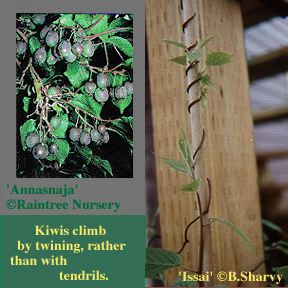
Hardy Kiwi is the most vigorous grower of the actinidias, requiring some sort of trellis or arbor; except for the less vigorous Issai cultivar, a simple fence won't do. The plant climbs by twining around vertical supports: it lacks tendrils and does not reach across supports very well. New foliage and blooms come early in spring and are damaged by freezes, so choose a site protected from low winter sun to delay early growth. Kiwis also like between 1/2 and 1-1/2 lbs of nitrogen annually (more for mature plants). All actinidias require a male (non-fruiting) pollinator within 30 ft. The pollinizer and pollinized may be different species, so long as their bloom-times overlap; hardy and fuzzy kiwis pollinate each other well, but arctic beauty blooms about two weeks earlier than the others. Actinidias are subject to crown rot when planted in wet soil; soil pH between 5 and 6.5 is best. The fruit will burn if unshaded in hot summer areas and deserts. Actinidias occasionally interest cats like catnip, usually to the detriment of the plant. Propagate by softwood cuttings and grafting.
Comment
The genus actindia has 3 good-fruiting species: A. deliciosa (the common kiwifruit, and least hardy), a. arguta ("hardy kiwi"), and a. kolomikta ("arctic beauty," hardy to -40 F). All originated in Asia, probably the hills and mountains of southwest China.
Cultivars of Repute
* Ananasnaja: large fruit ripening in
mid-September.
* Issai: A self-fertile, precocious variety that sets more fruit if pollinated. It is smaller and less hardy than other varieties.
* Meader: productive, medium sized fruit.
General References
[C= cultivation; R = recipes; L = lore; A = all]
* Reich [C, L]