Pineapple Guava; Feijoa (Feijoa sellowiana)
- USDA Zones: (8)90
- Plant Type: Tree/Shrub
- Yield: ?
- Storable: Not
- Bears: Promptly
- Shape: Shrubby
- Height: 10-25ft
- Spread: 7-15ft
- Lifespan: ?
- Growth: Slow
- Pruning: Recommended
- Origin: S America
- Food Type: Fruit,Flower,
- Appearance: Evergreen,Ornamental,Flowers,
- Uses: Fresh,Hedge,Birds,Preserves,
- Misc. Features: Pottable,Seedlings,Self-productive,Trainable,
- Prefers: Loam,
- Rejects: Heat,Soggy soil,
- Problems: [MINIMAL],
- Cycles: Late spring bloom,Very late harvest
Do not bookmark this page! Bookmark the plant index instead.
Pistachio (Pistacia vera)
- USDA Zones: 789(0)
- Plant Type: Tree/Shrub
- Yield: 10-35 lbs
- Storable: 5 months
- Bears: 6-8 yrs
- Shape: Shrubby
- Height: 25-50ft
- Spread: 25-45ft
- Lifespan: Human
- Growth: Slow
- Pruning: Recommended
- Origin: Arabia
- Food Type: Nut,
- Appearance: Fall color,Ornamental,
- Uses: Fresh,Hedge,Windbreak,
- Misc. Features: None
- Prefers: Alkalinity,
- Rejects: Part-shade,Soggy soil,
- Problems: [MINIMAL],Verticillium,
- Cycles: ?
Harvest & Use
Nuts must be shaken from tree or knocked down with poles, and are typically sun dried. Pistachio nuts will keep several months frozen. They are high in protein and thiamin. The northern cardinal, Carolina
chickadee, tufted titmouse, myrtle warble, brown-headed nuthatch eat the nut.
Appearance
Open habit, gray leaves, russet bark, delicately colored clusters of nuts. Brilliant yellow fall color. Females (nut-bearers) are in the smaller end of the plant's size range, typically 25' wide and 30' tall (unpruned).
Cultivation
Pistachios come in male and female varieties; males are taller. One male can reliably pollinize about 12 females. Pistachios resemble almonds in their climatic needs, but are slightly more tolerant of cold and late frost. They are very drought tolerant, once established. Requires 800-1000 chill hours.
Comment
The pistachio is native to Syria, and has been cultivated since the dawn of history, a botanical relation to poison ivy notwithstanding. Almonds, pistachios, and perhaps apples, were staples in the diet of Catul HŸyŸk, one of the world's first city-states (Asia Minor, 6500 BC). In the Bible, Jacob's sons unwittingly brought pistachios to Egypt as a gift for their (disguised) brother Joseph, whom they had previously sold into slavery.
Cultivars of Repute
Kerman, Red Aleppo, Peters (male)
Nuts must be shaken from tree or knocked down with poles, and are typically sun dried. Pistachio nuts will keep several months frozen. They are high in protein and thiamin. The northern cardinal, Carolina
chickadee, tufted titmouse, myrtle warble, brown-headed nuthatch eat the nut.
Appearance
Open habit, gray leaves, russet bark, delicately colored clusters of nuts. Brilliant yellow fall color. Females (nut-bearers) are in the smaller end of the plant's size range, typically 25' wide and 30' tall (unpruned).
Cultivation
Pistachios come in male and female varieties; males are taller. One male can reliably pollinize about 12 females. Pistachios resemble almonds in their climatic needs, but are slightly more tolerant of cold and late frost. They are very drought tolerant, once established. Requires 800-1000 chill hours.
Comment
The pistachio is native to Syria, and has been cultivated since the dawn of history, a botanical relation to poison ivy notwithstanding. Almonds, pistachios, and perhaps apples, were staples in the diet of Catul HŸyŸk, one of the world's first city-states (Asia Minor, 6500 BC). In the Bible, Jacob's sons unwittingly brought pistachios to Egypt as a gift for their (disguised) brother Joseph, whom they had previously sold into slavery.
Cultivars of Repute
Kerman, Red Aleppo, Peters (male)
Do not bookmark this page! Bookmark the plant index instead.
Plum, European; Prune (Prunus domestica)
Categories- USDA Zones: 45678
- Plant Type: Tree
- Yield: 10-35 lbs
- Storable: 1 month
- Bears: 4-6 yrs
- Shape: Oval
- Height: 25-50ft
- Spread: 15-25ft
- Lifespan: Sub-human
- Growth: ?
- Pruning: Optional
- Origin: Arabia
- Food Type: Fruit,Flower,
- Appearance: Ornamental,Flowers,
- Uses: Fresh,Dried,Butterflies,
- Misc. Features: Trainable,Self-productive,
- Prefers: None
- Rejects: Part-shade,
- Problems: Curculio,Leaf spot,Fungi,
- Cycles: Late spring bloom,Late harvest
Harvest & Use
Prunes are very sugary plums. Plum petals have a mild flavor and sweet fragrance. Most cherries and plums are larval food plants for the pale swallowtail butterfly.
Appearance
Late blooming, clouds of white or pink-white flowers. Typical unpruned tree is 25' wide by 30' tall; semi-dwarfs reach 15'.
Cultivation
Tolerates wet soils. The usual pruning system is the modified central leader. Japanese and European plums cannot cross-pollinize because they have different numbers of chromosomes.
Comment
There is great variety in plums--of fruit color, hardiness, sweetness, bloom-time, pollination needs, etc. The European plum is a natural hybrid of at least two, and probably more wild plums (hence the many phenotypes), one of which is the ancient sloe plum used in sloe gin. The Damson is often grouped with the European plums, but botanists classify it as a separate species (it may be an ancestor of the European plum). Damson is probably the oldest cultivated plum. It appears in ancient Mesopotamian records and probably grew in Babylon's Hanging Gardens; the popular name derives from the Latin name meaning "plum of Damascus." The prune came to Europe from Syria during the Middle Ages, as a result of the Crusades.
Cultivars of Repute
* Fellenberg ('Italian Prune'): large dark purple fruits are sweet, plentiful, and ripen in late August; they are good for prunes. The tree is disease resistant. Needs 800 chill hours.
* French Prune: Good for prunes.
* Green Gage: Yellow-green, plentiful fruit that is sweet and smooth, famous for fresh dessert eating. Needs 500-700 chill hours.
* Kirke's Blue: reputed to be the tastiest fresh plum; needs a pollinizer.
* Mirabelle: a self-sterile variety that does well in maritime climates. It is popular in the Alsace-Lorraine region of France (which is really Germany you know), and often used for brandies (and at least one Belgian beer). The tree spreads more than average; the fruit is yellow, speckled red. Recommended for all uses.
* Moyer: large and sweet, good fresh or pruned; developed in Oregon.
* Reine Claude Conducta
* Seneca: self-sterile, brown-rot resistant variety with large sweet purple fruit ripening in September.
* Victoria: popular in England since the mid- nienteenth-century. 'Victoria' comes most recommended for canning and preserves. It ripens late in August.
General References
* Grigson [R,L]
Prunes are very sugary plums. Plum petals have a mild flavor and sweet fragrance. Most cherries and plums are larval food plants for the pale swallowtail butterfly.
Appearance
Late blooming, clouds of white or pink-white flowers. Typical unpruned tree is 25' wide by 30' tall; semi-dwarfs reach 15'.
Cultivation
Tolerates wet soils. The usual pruning system is the modified central leader. Japanese and European plums cannot cross-pollinize because they have different numbers of chromosomes.
Comment
There is great variety in plums--of fruit color, hardiness, sweetness, bloom-time, pollination needs, etc. The European plum is a natural hybrid of at least two, and probably more wild plums (hence the many phenotypes), one of which is the ancient sloe plum used in sloe gin. The Damson is often grouped with the European plums, but botanists classify it as a separate species (it may be an ancestor of the European plum). Damson is probably the oldest cultivated plum. It appears in ancient Mesopotamian records and probably grew in Babylon's Hanging Gardens; the popular name derives from the Latin name meaning "plum of Damascus." The prune came to Europe from Syria during the Middle Ages, as a result of the Crusades.
Cultivars of Repute
* Fellenberg ('Italian Prune'): large dark purple fruits are sweet, plentiful, and ripen in late August; they are good for prunes. The tree is disease resistant. Needs 800 chill hours.
* French Prune: Good for prunes.
* Green Gage: Yellow-green, plentiful fruit that is sweet and smooth, famous for fresh dessert eating. Needs 500-700 chill hours.
* Kirke's Blue: reputed to be the tastiest fresh plum; needs a pollinizer.
* Mirabelle: a self-sterile variety that does well in maritime climates. It is popular in the Alsace-Lorraine region of France (which is really Germany you know), and often used for brandies (and at least one Belgian beer). The tree spreads more than average; the fruit is yellow, speckled red. Recommended for all uses.
* Moyer: large and sweet, good fresh or pruned; developed in Oregon.
* Reine Claude Conducta
* Seneca: self-sterile, brown-rot resistant variety with large sweet purple fruit ripening in September.
* Victoria: popular in England since the mid- nienteenth-century. 'Victoria' comes most recommended for canning and preserves. It ripens late in August.
General References
* Grigson [R,L]
Do not bookmark this page! Bookmark the plant index instead.
Plum, Japanese (Prunus salicina)
- USDA Zones: 56789
- Plant Type: Tree
- Yield: 10-35 lbs
- Storable: Not
- Bears: 2-4 yrs
- Shape: Arching
- Height: 25-50ft
- Spread: 15-25ft
- Lifespan: Sub-human
- Growth: Fast
- Pruning: Necessary
- Origin: E Asia
- Food Type: Fruit,Flower,
- Appearance: Flowers,
- Uses: Fresh,Cooked,Preserves,Butterflies,
- Misc. Features: Trainable,Dwarfs,Self-productive,
- Prefers: Loam,
- Rejects: Poor soil,
- Problems: Leaf spot,
- Cycles: Early spring bloom,Midseason harvest
Harvest & Use
Japanese plums tend to be juicier than European ones, and are used mainly for fresh eating. Some experts recommend picking slightly underripe, and storing in a cool place. The petals have a mild flavor and sweet fragrance. Most cherries and plums are larval food plants to the pale swallowtail butterfly.
Appearance
Clouds of white or pink-white flowers; broad oval leaves. Typical unpruned tree, not on dwarfing rootstock, is 25' wide by 30' tall.
Cultivation
Japanese plums tend to overgrow and overbear: they need pruning and crop-thinning for good health. They are usually pruned to have an open center. Generally requires 600-1600 chill hours; 'Methley,' 'Santa Rosa' and 'Beauty' are low-chill varieties. Japanese and European plums cannot cross-pollinize, because they have different numbers of chromosomes. The Research Department couldn't turn up any genetic dwarf varieties: reduced height (10-15') is achieved by grafting onto a dwarfing rootstock (usually St. Julian A); see also 'Weeping Santa Rosa' in the list of cultivars.
Comment
There is great variety in plums--of fruit color, hardiness, sweetness, bloom-time, pollination needs, etc. The plum is prominent in Chinese life and legend: Lao-tse was born beneath one. In The Lore of the Chinese Lute, R.H. van Gulik writes:
Chinese poets and painters have never tired of the delicate beauty of the plum blossom....Poets celebrate the subtle color and subdued fragrance of the plum blossom, and they admire the intriguing contrast of the tender flowers and the crooked and rough branches of the tree....When there is a light breeze, the falling plum blossoms shall suggest [to the Lute player] the spirit of the more delicate touches of finger technique....
Just like the crane, the plum blossom is said to be sensitive to the beauty of Lute music. The Ch'ing-lien-fang-ch'in-ya tells the following story. "Wang Tzu-liang obtained a Lute of very antique appearance. Every time he played it, a gentle breeze made the plum blossoms in his garden flutter down in a dancing motion. Tzu-liang sighed, 'These blossoms not only understand words, they understand music.'"
Cultivars of Repute * = self-fruitful
* Beauty*: fast growing, productive, purple-red fruit with juicy golden flesh; only partly self-fruitful. Needs 250-500 chill hours.
* Flavor Queen Pluot: this patented plant is 3/4 plum, 1/4 apricot, with yellow skin and flesh.
* Hollywood*: highly ornamental variety; the leaves are purple-red, as are the fruits which ripen in August.
* Methley*: purple-red fruit with red flesh; productive and reliable. Needs 200-300 chill hours.
* Ozark Premiere: very large red fruits with yellow flesh.
* Santa Rosa*: available in an ornamental weeping variety (good choice for a short tree); fruit similar to 'Beauty'. 300-400 chill hours.
* Satsuma: medium-sized fruit with red skin and flesh. Needs 300-500 chill hours.
* Shiro: round yellow fruit and extremely juicy flesh; slightly self-fruitful. 600 chill hours.
* Underwood: Japanese-American cross that is allegedly hardy to zone 2. The fruit is mild with dark red skin; needs a pollinizer.
Japanese plums tend to be juicier than European ones, and are used mainly for fresh eating. Some experts recommend picking slightly underripe, and storing in a cool place. The petals have a mild flavor and sweet fragrance. Most cherries and plums are larval food plants to the pale swallowtail butterfly.
Appearance
Clouds of white or pink-white flowers; broad oval leaves. Typical unpruned tree, not on dwarfing rootstock, is 25' wide by 30' tall.
Cultivation
Japanese plums tend to overgrow and overbear: they need pruning and crop-thinning for good health. They are usually pruned to have an open center. Generally requires 600-1600 chill hours; 'Methley,' 'Santa Rosa' and 'Beauty' are low-chill varieties. Japanese and European plums cannot cross-pollinize, because they have different numbers of chromosomes. The Research Department couldn't turn up any genetic dwarf varieties: reduced height (10-15') is achieved by grafting onto a dwarfing rootstock (usually St. Julian A); see also 'Weeping Santa Rosa' in the list of cultivars.
Comment
There is great variety in plums--of fruit color, hardiness, sweetness, bloom-time, pollination needs, etc. The plum is prominent in Chinese life and legend: Lao-tse was born beneath one. In The Lore of the Chinese Lute, R.H. van Gulik writes:
Chinese poets and painters have never tired of the delicate beauty of the plum blossom....Poets celebrate the subtle color and subdued fragrance of the plum blossom, and they admire the intriguing contrast of the tender flowers and the crooked and rough branches of the tree....When there is a light breeze, the falling plum blossoms shall suggest [to the Lute player] the spirit of the more delicate touches of finger technique....
Just like the crane, the plum blossom is said to be sensitive to the beauty of Lute music. The Ch'ing-lien-fang-ch'in-ya tells the following story. "Wang Tzu-liang obtained a Lute of very antique appearance. Every time he played it, a gentle breeze made the plum blossoms in his garden flutter down in a dancing motion. Tzu-liang sighed, 'These blossoms not only understand words, they understand music.'"
Cultivars of Repute * = self-fruitful
* Beauty*: fast growing, productive, purple-red fruit with juicy golden flesh; only partly self-fruitful. Needs 250-500 chill hours.
* Flavor Queen Pluot: this patented plant is 3/4 plum, 1/4 apricot, with yellow skin and flesh.
* Hollywood*: highly ornamental variety; the leaves are purple-red, as are the fruits which ripen in August.
* Methley*: purple-red fruit with red flesh; productive and reliable. Needs 200-300 chill hours.
* Ozark Premiere: very large red fruits with yellow flesh.
* Santa Rosa*: available in an ornamental weeping variety (good choice for a short tree); fruit similar to 'Beauty'. 300-400 chill hours.
* Satsuma: medium-sized fruit with red skin and flesh. Needs 300-500 chill hours.
* Shiro: round yellow fruit and extremely juicy flesh; slightly self-fruitful. 600 chill hours.
* Underwood: Japanese-American cross that is allegedly hardy to zone 2. The fruit is mild with dark red skin; needs a pollinizer.
Do not bookmark this page! Bookmark the plant index instead.
Pomegranate (Punica granatum)
Categories- USDA Zones: 890
- Plant Type: Tree/Shrub
- Yield: 35-75 lbs
- Storable: 3 months
- Bears: 2-4 yrs
- Shape: Shrubby
- Height: 10-25ft
- Spread: 7-15ft
- Lifespan: Long
- Growth: ?
- Pruning: Recommended
- Origin: Arabia
- Food Type: Fruit,
- Appearance: Ornamental,Flowers,Fall color,
- Uses: Fresh,Preserves,Medicinal,
- Misc. Features: Self-productive,Trainable,Pottable,
- Prefers: Heat,Loam,
- Rejects: Part-shade,Soggy soil,
- Problems: [MINIMAL],Leaf spot,
- Cycles: Late spring bloom,Midseason harvest
Harvest & Use
Squish it without breaking the skin, stick in a straw, and suck. Make a sherbet. Or sprinkle the seeds in salads or any other dish you like. The fruits are high in potassium. According to Mohammed, pomegranates "purge the system of envy and hatred." According to Pliny, they purge it of tapeworm.
Appearance
Pomegranates rarely grow taller or wider than 15'. They have long-lasting showy red bell-shaped flowers, and glossy green leaves; fruits from 2" to 5" in diameter. Suckers wildly.
Cultivation
The warmer the climate, the sweeter the fruit; a hot summer is essential to ripen the fruit. Ripening is experimental in zone 8; in cool summer areas 'Eversweet' is a popular choice. The pomegranate tolerates salinity well. It is difficult to graft, but grows readily from cuttings.100-200 chill hours.
Comment
The pomegranate is probably native to Asia Minor. Only the fig can match the pomegranate in mythical and Biblical presence. In ancient Greece, the fruit was associated with fertility due to its multitude of delicious seeds and association with Persephone; Aphrodite planted it on earth; its juice is the blood of the god Dionysius. In the Homeric Hymn to Demeter, Hades forces Persephone to eat a pomegranate seed in order to bond her to the underworld: consumption of pomegranates was consequently either forbidden or required (depending on the season) of women during their Eleusinian mystery rites. In Christian traditions, resurrection symbolism often parallels the fertility symbolism of pagan religions, a pattern exemplified in Botticelli's "Madonna of the Pomegranate" ( http://vrcoll.fa.pitt.edu/uag/Art-Anytime-Page/Lochoff-pages/pages/20-Boticelli-Madonna.htm), which shows baby Jesus clutching the fruit. The 1769 entry in Thomas Jefferson's Garden Book reveals that the first orchard he planted at Monticello contained 12 pomegranates, as well as almond, apricot, fig, nectarine, quince, and others. Pomum is another Latin word for fruit (leading to the words "pome" and "pomology") and granum is a Latin term for seed (e.g. "grain"), hence "pomegranate": a fruit notable for its seeds; grenades got their name due to a resemblance to pomegranates. A dwarf form is popular in Japanese bonsai.
Cultivars of Repute
Wonderful, Fleishman's. 'Eversweet' is an early ripening selection that grows to 10'.
General References
[C= cultivation; R = recipes; L = lore; A = all]
* Grigson [R,L]
* Schneider [R]
* Simmons [C, L]
Squish it without breaking the skin, stick in a straw, and suck. Make a sherbet. Or sprinkle the seeds in salads or any other dish you like. The fruits are high in potassium. According to Mohammed, pomegranates "purge the system of envy and hatred." According to Pliny, they purge it of tapeworm.
Appearance
Pomegranates rarely grow taller or wider than 15'. They have long-lasting showy red bell-shaped flowers, and glossy green leaves; fruits from 2" to 5" in diameter. Suckers wildly.
Cultivation
The warmer the climate, the sweeter the fruit; a hot summer is essential to ripen the fruit. Ripening is experimental in zone 8; in cool summer areas 'Eversweet' is a popular choice. The pomegranate tolerates salinity well. It is difficult to graft, but grows readily from cuttings.100-200 chill hours.
Comment
The pomegranate is probably native to Asia Minor. Only the fig can match the pomegranate in mythical and Biblical presence. In ancient Greece, the fruit was associated with fertility due to its multitude of delicious seeds and association with Persephone; Aphrodite planted it on earth; its juice is the blood of the god Dionysius. In the Homeric Hymn to Demeter, Hades forces Persephone to eat a pomegranate seed in order to bond her to the underworld: consumption of pomegranates was consequently either forbidden or required (depending on the season) of women during their Eleusinian mystery rites. In Christian traditions, resurrection symbolism often parallels the fertility symbolism of pagan religions, a pattern exemplified in Botticelli's "Madonna of the Pomegranate" ( http://vrcoll.fa.pitt.edu/uag/Art-Anytime-Page/Lochoff-pages/pages/20-Boticelli-Madonna.htm), which shows baby Jesus clutching the fruit. The 1769 entry in Thomas Jefferson's Garden Book reveals that the first orchard he planted at Monticello contained 12 pomegranates, as well as almond, apricot, fig, nectarine, quince, and others. Pomum is another Latin word for fruit (leading to the words "pome" and "pomology") and granum is a Latin term for seed (e.g. "grain"), hence "pomegranate": a fruit notable for its seeds; grenades got their name due to a resemblance to pomegranates. A dwarf form is popular in Japanese bonsai.
Cultivars of Repute
Wonderful, Fleishman's. 'Eversweet' is an early ripening selection that grows to 10'.
General References
[C= cultivation; R = recipes; L = lore; A = all]
* Grigson [R,L]
* Schneider [R]
* Simmons [C, L]
Do not bookmark this page! Bookmark the plant index instead.
Quince (Cydonia oblonga)
- USDA Zones: (5)6789
- Plant Type: Tree
- Yield: Fair
- Storable: 1 month
- Bears: 2-4 yrs
- Shape: Round
- Height: 10-25ft
- Spread: 15-25ft
- Lifespan: Sub-human
- Growth: Slow
- Pruning: Optional
- Origin: Arabia
- Food Type: Fruit,
- Appearance: Ornamental,Flowers,
- Uses: Cooked,Preserves,
- Misc. Features: Self-productive,Fragrant,
- Prefers: Clayey,
- Rejects: Sandy,Part-shade,
- Problems: [MINIMAL],Fireblight,Codling moth,
- Cycles: Late spring bloom,Late harvest
Harvest & Use
Inedible raw, makes delicious preserves and an exciting contribution to applesauce.
Appearance
A highly ornamental tree, with large, cupped pink or white flowers, woolly deep green leaves, and, with maturity, a gnarled form. Typical height and width equals 20'. The fruit is usually yellow and can weigh up to a pound.
Cultivation
The quince shrugs off most pests and diseases. It prefers a moist (but well-drained) site. It can be trained as a shrub. 200-400 chill hours.
Comment
The Greeks and Romans dedicated the quince to Aphrodite (Venus), the goddess of love. They used it as a symbol of happiness and fertility, and in marriage ceremonies, in spite (or because?) of its mouth-puckering quality. Allegedly, marmalade was invented as a result of trying to find something useful to do with quinces. The quince made its first European appearance as a Roman import circa 100 C.E. The 1769 entry in Thomas Jefferson's Garden Book itemizes his first orchard at Monticello as follows: almond, apple, apricot, cherry (probably sour), fig, nectarine, pear, pomegranate, quince and walnut. The original, Greek, name for the fruit meant "Cydonian apple," and the name "quince" derives from "Cydonia" (or "Chania") a Cretan port from which the fruit was exported.
Cultivars of Repute
* Champion
* Orange: large fruit with orange flesh that turns red when cooked. Good for areas with cool summers.
* Pineapple: a productive producer of round, white-fleshed fruit that imparts a pineapple flavor to jelly.
* Smyrna: very large, oblong fruit with yellow skin and mild, rich flavor and fragrance.
General References
[C= cultivation; R = recipes; L = lore; A = all]
* Bryan [A]
* Kourik [C, R]
* Schneider [R]
* Simmons [C, L]
Inedible raw, makes delicious preserves and an exciting contribution to applesauce.
Appearance
A highly ornamental tree, with large, cupped pink or white flowers, woolly deep green leaves, and, with maturity, a gnarled form. Typical height and width equals 20'. The fruit is usually yellow and can weigh up to a pound.
Cultivation
The quince shrugs off most pests and diseases. It prefers a moist (but well-drained) site. It can be trained as a shrub. 200-400 chill hours.
Comment
The Greeks and Romans dedicated the quince to Aphrodite (Venus), the goddess of love. They used it as a symbol of happiness and fertility, and in marriage ceremonies, in spite (or because?) of its mouth-puckering quality. Allegedly, marmalade was invented as a result of trying to find something useful to do with quinces. The quince made its first European appearance as a Roman import circa 100 C.E. The 1769 entry in Thomas Jefferson's Garden Book itemizes his first orchard at Monticello as follows: almond, apple, apricot, cherry (probably sour), fig, nectarine, pear, pomegranate, quince and walnut. The original, Greek, name for the fruit meant "Cydonian apple," and the name "quince" derives from "Cydonia" (or "Chania") a Cretan port from which the fruit was exported.
Cultivars of Repute
* Champion
* Orange: large fruit with orange flesh that turns red when cooked. Good for areas with cool summers.
* Pineapple: a productive producer of round, white-fleshed fruit that imparts a pineapple flavor to jelly.
* Smyrna: very large, oblong fruit with yellow skin and mild, rich flavor and fragrance.
General References
[C= cultivation; R = recipes; L = lore; A = all]
* Bryan [A]
* Kourik [C, R]
* Schneider [R]
* Simmons [C, L]
Do not bookmark this page! Bookmark the plant index instead.
Raisin Tree (Hovenia dulcis)
Categories- USDA Zones: (5)6789
- Plant Type: Tree
- Yield: Fair
- Storable: Not
- Bears: Promptly
- Shape: Round
- Height: 25-50ft
- Spread: 15-25ft
- Lifespan: ?
- Growth: Moderate
- Pruning: Optional
- Origin: E Asia
- Food Type: Other,
- Appearance: Ornamental,Flowers,
- Uses: Fresh,
- Misc. Features: Self-productive,Seedlings,Fragrant,
- Prefers: Part-shade,Loam,
- Rejects: Heat,Drought,
- Problems: [MINIMAL],
- Cycles: Summer bloom,Late harvest
Harvest & Use
The "fruit" of this tree is the flower stalk, which swells into a russet mass after the flowers fall. Pick the stalks when they are swollen (late in the year) or let them fall; the taste is sweet with hints of pear, and slightly astringent. The Chinese make a sweet extract from the stalks and leaves, which allegedly eliminates hangovers. The leaf is reported by some to be edible raw, but I've tried it and would have to disagree (quality may vary from tree to tree).
Appearance
Glossy, oval leaves; creamy, slightly showy, fragrant flowers in 3" clusters. Average dimensions at maturity are 30' tall and 20' wide, although 70' tall is known. The bark is grey, and furrowed on older trees. "In leaf, form, and texture, the plant resembles the American basswood...and, like the basswood, possesses a beauty that is quiet rather than striking" (Reich).
Cultivation
The raisin tree isn't fussy about soil, but thrives in sandy loam. The tops of unestablished raisin trees may die back in the colder winters. They grow back during the summer. The tree usually grows one or two feet per year when young. The raisin tree is usually propagated by seed, or softwood or root cuttings. The seed has a impermeable coat which delays germination; scraping it with sandpaper, nicking it, soaking it in coffee (anything acidic) are typical solutions. Sources describe germination times as from one week to over a month. Propagation by softwood- and root-cuttings is more common.
Comment
The Chinese have cultivated this tree for centuries. It was introduced to the West in the early 19th century.
General References
[C= cultivation; R = recipes; L = lore; A = all]
* Reich [C, L]
The "fruit" of this tree is the flower stalk, which swells into a russet mass after the flowers fall. Pick the stalks when they are swollen (late in the year) or let them fall; the taste is sweet with hints of pear, and slightly astringent. The Chinese make a sweet extract from the stalks and leaves, which allegedly eliminates hangovers. The leaf is reported by some to be edible raw, but I've tried it and would have to disagree (quality may vary from tree to tree).
Appearance
Glossy, oval leaves; creamy, slightly showy, fragrant flowers in 3" clusters. Average dimensions at maturity are 30' tall and 20' wide, although 70' tall is known. The bark is grey, and furrowed on older trees. "In leaf, form, and texture, the plant resembles the American basswood...and, like the basswood, possesses a beauty that is quiet rather than striking" (Reich).
Cultivation
The raisin tree isn't fussy about soil, but thrives in sandy loam. The tops of unestablished raisin trees may die back in the colder winters. They grow back during the summer. The tree usually grows one or two feet per year when young. The raisin tree is usually propagated by seed, or softwood or root cuttings. The seed has a impermeable coat which delays germination; scraping it with sandpaper, nicking it, soaking it in coffee (anything acidic) are typical solutions. Sources describe germination times as from one week to over a month. Propagation by softwood- and root-cuttings is more common.
Comment
The Chinese have cultivated this tree for centuries. It was introduced to the West in the early 19th century.
General References
[C= cultivation; R = recipes; L = lore; A = all]
* Reich [C, L]
Do not bookmark this page! Bookmark the plant index instead.
Raspberry (Rubus idaeus; R. occidentalis)
Categories- USDA Zones: (3)45678(9)
- Plant Type: Cane
- Yield: Fair
- Storable: Not
- Bears: 2-4 yrs
- Shape: Shrubby
- Height: 4-10ft
- Spread: 1-7ft
- Lifespan: Sub-dog
- Growth: ?
- Pruning: Recommended
- Origin: Europe
- Food Type: Fruit,
- Appearance: None
- Uses: Fresh,Preserves,Hedge,Butterflies,Medicinal,
- Misc. Features: Self-productive,Pottable,
- Prefers: Loam,
- Rejects: Heat,Drought,Soggy soil,Poor soil,
- Problems: Verticillium,Rust,
- Cycles: ?
Harvest & Use
Early-bearing raspberries tend to be tarter than the fall-bearing ones; yellow rasberries are alleged to taste best. Tea from raspberry leaves is an ancient folkloric drink for pregnant women, said to reduce miscarriage, ease childbirth, and improve lactation (and, as a value-added bonus, reduce diarrhea in infants). The young shoots, peeled, are edible--delectable to deer and horses. The fruit is often combined with currants in cooking, but most often of all it is consumed fresh. The fruits attract birds of many sorts. The brown thrasher, gray catbird, northern cardinal, northern mockingbird, and white-eyed vireo will nest in blackberries and raspberries. The flowers attract butterflies.
Appearance
Dark green leaves with prickly stems and small pink-white flowers. Grows on upright canes and spreads indefinitely with suckers.
Cultivation
It's a good idea to trellis raspberries to keep the canes off the ground; two wires about 3 and 5 feet tall will do. The roots spread far and wide, so 4' spacing is the minimum. Soil should be slightly acidic and rich in humus and potash. Canes that fruited should be pruned at the end of each season, leaving one-year old canes that will fruit most vigorously next season. Raspberries prefer full sun but will fruit in part-shade. Wild varieties require cross-pollination; black raspberries (R. occidentalis) are only hardy to zone 5, and especially prone to disease when grown with red raspberries. Deer enjoy the young shoots.... 100-1800 chill hours.
Comment
Red raspberries are native to southeast Europe and/or Asia; the black raspberry is North American. Raspberry cultivation began in the Middle Ages, spreading to North America in the 19th century. Raspberries contain ionone, which is also the fragrant molecule in violets (Violeta odorata) and fresh-cut hay (Atkins:129).
Cultivars of Repute [ideal zones]
Red or Yellow (upright):
* Amber: productive, flavorful, yellow fruit.
* Autumn Bliss: disease resistant; early ripening and everbearing.
* Canby: thornless, rejects heavy soil; loses flavor when cooked. [5-8]
* Fairview: excellent frozen or fresh; good for heavy soils. [5-8]
* Fallgold: everbearing, early ripening, excellent fresh, large yellow fruit. [3-8]
* Fallred: very large berry, everbearing.
* Indian Summer: everbearing, large fruit good fresh and for cooking.
* Sumner: excellent for all uses, early ripening, tolerates heavy soil. [5-8]
* Taylor: productive, tasty, late ripening.
* Viking: thornless, hardy and flavorful.
Black (trailing)
* Amethyst: highly rated flavor, early ripening
* Black Hawk: very productive, late ripening.
* Bristol: nearly seedless fruit. The plant is vigorous and productive [5-8]
* Columbian: a red-black cross with large purple fruit. Not disease resistant.
* Cumberland: This is the most popular variety of black raspberry. The plant is vigorous, productive, but not disease-resistant. Fruit is excellent.
General References
[C= cultivation; R = recipes; L = lore; A = all]
* Bryan [A]
* Grigson [R,L]
Early-bearing raspberries tend to be tarter than the fall-bearing ones; yellow rasberries are alleged to taste best. Tea from raspberry leaves is an ancient folkloric drink for pregnant women, said to reduce miscarriage, ease childbirth, and improve lactation (and, as a value-added bonus, reduce diarrhea in infants). The young shoots, peeled, are edible--delectable to deer and horses. The fruit is often combined with currants in cooking, but most often of all it is consumed fresh. The fruits attract birds of many sorts. The brown thrasher, gray catbird, northern cardinal, northern mockingbird, and white-eyed vireo will nest in blackberries and raspberries. The flowers attract butterflies.
Appearance
Dark green leaves with prickly stems and small pink-white flowers. Grows on upright canes and spreads indefinitely with suckers.
Cultivation
It's a good idea to trellis raspberries to keep the canes off the ground; two wires about 3 and 5 feet tall will do. The roots spread far and wide, so 4' spacing is the minimum. Soil should be slightly acidic and rich in humus and potash. Canes that fruited should be pruned at the end of each season, leaving one-year old canes that will fruit most vigorously next season. Raspberries prefer full sun but will fruit in part-shade. Wild varieties require cross-pollination; black raspberries (R. occidentalis) are only hardy to zone 5, and especially prone to disease when grown with red raspberries. Deer enjoy the young shoots.... 100-1800 chill hours.
Comment
Red raspberries are native to southeast Europe and/or Asia; the black raspberry is North American. Raspberry cultivation began in the Middle Ages, spreading to North America in the 19th century. Raspberries contain ionone, which is also the fragrant molecule in violets (Violeta odorata) and fresh-cut hay (Atkins:129).
Cultivars of Repute [ideal zones]
Red or Yellow (upright):
* Amber: productive, flavorful, yellow fruit.
* Autumn Bliss: disease resistant; early ripening and everbearing.
* Canby: thornless, rejects heavy soil; loses flavor when cooked. [5-8]
* Fairview: excellent frozen or fresh; good for heavy soils. [5-8]
* Fallgold: everbearing, early ripening, excellent fresh, large yellow fruit. [3-8]
* Fallred: very large berry, everbearing.
* Indian Summer: everbearing, large fruit good fresh and for cooking.
* Sumner: excellent for all uses, early ripening, tolerates heavy soil. [5-8]
* Taylor: productive, tasty, late ripening.
* Viking: thornless, hardy and flavorful.
Black (trailing)
* Amethyst: highly rated flavor, early ripening
* Black Hawk: very productive, late ripening.
* Bristol: nearly seedless fruit. The plant is vigorous and productive [5-8]
* Columbian: a red-black cross with large purple fruit. Not disease resistant.
* Cumberland: This is the most popular variety of black raspberry. The plant is vigorous, productive, but not disease-resistant. Fruit is excellent.
General References
[C= cultivation; R = recipes; L = lore; A = all]
* Bryan [A]
* Grigson [R,L]
Do not bookmark this page! Bookmark the plant index instead.
Rhubarb (Rheum rhaponticum)
Categories- USDA Zones: (3)45678
- Plant Type: Herbaceous
- Yield: Fair
- Storable: 3 months
- Bears: 2-4 yrs
- Shape: None
- Height: 4-10ft
- Spread: 1-7ft
- Lifespan: ?
- Growth: Fast
- Pruning: None
- Origin: Asia
- Food Type: Other,Flower,
- Appearance: Flowers,Ornamental,
- Uses: Cooked,Preserves,Booze,
- Misc. Features: Self-productive,
- Prefers: Acidity,
- Rejects: Alkalinity,Drought,
- Problems: Curculio,
- Cycles: Early leaf,Early harvest
Harvest & Use
Rhubarb leaves are toxic, a property commonly but perhaps erroneously attributed to high levels of oxalic acid. The chemist P.W. Atkins writes:
The toxicity of rhubarb leaves was once ascribed to the presence of oxalic acid; however, spinach is rich in salts of the acid but not toxic. It seems that the compound responsible for rhubarb-leaf toxicity has not yet been identified. (Atkins: 111)
Nonetheless, oxalic acid is used industrially to clean metals.... The stalks, which are what you eat, contain smaller amounts of the acid. The stalk is succulent and very tart; the Joy of Cooking recommends cooking it with elderberries, strawberries, or cherries. Don't pick stems the first year; in subsequent years, pick the oldest (thickest) stems through July, leaving at least half the plant each year. The flavor declines in late summer. Pick stems by breaking them off at the base, rather than cutting (cutting causes rot), so that the end has a spoon shape. Flower stalks are usually snipped because they reduce stem quality (but some people deep-fry the flowers). Rhubarb provides food in early spring, when little else is available. It's good in pie, jam, and wine. It is best stored by freezing.
Appearance
A huge-leafed bushy green plant growing up to 9' in cool climates, less in hot climates. The large leaves are elongated, crinkly, and heart shaped. The stalks are usually red, occasionally green; cool summer temperatures intensify the redness of the stalks. Flowers are yellow-green, but flowering comes at the expense of stem quality. The tops die back in winter.
Cultivation
Summer temperature must not stay consistently above 75¡ F, and winter temperature must dwell below 40¡ F with some regularity. It can be grown as an annual in zones 9 and 10. Rhubarb tolerates shade. Rhubarb likes plenty of compost. It grows from large, fleshy rhizomes and is usually propagated from rooted crowns or root cuttings. It doesn't grow true to seed. The young plants are frost-hardy. Growth will begin earlier in spring if the mulch is pulled away so that the soil warms faster. Rhubarb can be forced in early spring. PH of 5.0 to 6.0 is best. Regular watering is important, but soggy soil will cause root rot. Rhubarb has one big pest: rhubarb curculio, which is common around dock, a common yard weed. Deer supposedly show little interest in rhubarb.
Comment
Rhubarb is native to Mongolia. It was first cultivated for its roots, for unknown medicinal purposes. Rhubarb didn't emerge as a food item until the early 19th century, in England. It is more popular in Europe than North America, and most of the cultivated varieties are difficult to acquire in the U.S. The name "rhubarb" is said to come from "Rha," an ancient name for the Russian river Volga along which the plant was grown.
Cultivars of Repute
* Crimson Cherry: A variety with very red, thick stalks, lower growing than average, late-bearing.
* Glaskin's Perpetual: green-stalked variety.
* McDonald's Canadian Red: developed in Canada, good for cold regions.
* Victoria: a popular variety with thin, light red stalks.
General References
[C= cultivation; R = recipes; L = lore; A = all]
* Atkins [L]
* Bryan [A]
* Grigson [R,L]
+ The Rhubarb Compendium is a popular Web site: http://www.rhubarbinfo.com
Rhubarb leaves are toxic, a property commonly but perhaps erroneously attributed to high levels of oxalic acid. The chemist P.W. Atkins writes:
The toxicity of rhubarb leaves was once ascribed to the presence of oxalic acid; however, spinach is rich in salts of the acid but not toxic. It seems that the compound responsible for rhubarb-leaf toxicity has not yet been identified. (Atkins: 111)
Nonetheless, oxalic acid is used industrially to clean metals.... The stalks, which are what you eat, contain smaller amounts of the acid. The stalk is succulent and very tart; the Joy of Cooking recommends cooking it with elderberries, strawberries, or cherries. Don't pick stems the first year; in subsequent years, pick the oldest (thickest) stems through July, leaving at least half the plant each year. The flavor declines in late summer. Pick stems by breaking them off at the base, rather than cutting (cutting causes rot), so that the end has a spoon shape. Flower stalks are usually snipped because they reduce stem quality (but some people deep-fry the flowers). Rhubarb provides food in early spring, when little else is available. It's good in pie, jam, and wine. It is best stored by freezing.
Appearance
A huge-leafed bushy green plant growing up to 9' in cool climates, less in hot climates. The large leaves are elongated, crinkly, and heart shaped. The stalks are usually red, occasionally green; cool summer temperatures intensify the redness of the stalks. Flowers are yellow-green, but flowering comes at the expense of stem quality. The tops die back in winter.
Cultivation
Summer temperature must not stay consistently above 75¡ F, and winter temperature must dwell below 40¡ F with some regularity. It can be grown as an annual in zones 9 and 10. Rhubarb tolerates shade. Rhubarb likes plenty of compost. It grows from large, fleshy rhizomes and is usually propagated from rooted crowns or root cuttings. It doesn't grow true to seed. The young plants are frost-hardy. Growth will begin earlier in spring if the mulch is pulled away so that the soil warms faster. Rhubarb can be forced in early spring. PH of 5.0 to 6.0 is best. Regular watering is important, but soggy soil will cause root rot. Rhubarb has one big pest: rhubarb curculio, which is common around dock, a common yard weed. Deer supposedly show little interest in rhubarb.
Comment
Rhubarb is native to Mongolia. It was first cultivated for its roots, for unknown medicinal purposes. Rhubarb didn't emerge as a food item until the early 19th century, in England. It is more popular in Europe than North America, and most of the cultivated varieties are difficult to acquire in the U.S. The name "rhubarb" is said to come from "Rha," an ancient name for the Russian river Volga along which the plant was grown.
Cultivars of Repute
* Crimson Cherry: A variety with very red, thick stalks, lower growing than average, late-bearing.
* Glaskin's Perpetual: green-stalked variety.
* McDonald's Canadian Red: developed in Canada, good for cold regions.
* Victoria: a popular variety with thin, light red stalks.
General References
[C= cultivation; R = recipes; L = lore; A = all]
* Atkins [L]
* Bryan [A]
* Grigson [R,L]
+ The Rhubarb Compendium is a popular Web site: http://www.rhubarbinfo.com
Do not bookmark this page! Bookmark the plant index instead.
Rose Hips; Rugosa Rose (Rosa rugosa; R. eglanteria)
Categories- USDA Zones: 2345678(9)
- Plant Type: Shrub
- Yield: Fair
- Storable: ?
- Bears: ?
- Shape: Shrubby
- Height: 4-10ft
- Spread: 1-7ft
- Lifespan: ?
- Growth: Fast
- Pruning: Optional
- Origin: E Asia
- Food Type: Fruit,Flower,
- Appearance: Flowers,Thorns,Ornamental,
- Uses: Hedge,Cooked,Preserves,Medicinal,
- Misc. Features: Seedlings,Fragrant,
- Prefers: None
- Rejects: Soggy soil,
- Problems: [MINIMAL],Aphids,Japanese beetle,Fireblight,
- Cycles: Summer bloom,Late harvest
Harvest & Use
A vitamin C source par excellence. The hips are often used for tea. The petals are also edible, and sometimes find their way into vinegars, jellies, and potpourri. The Navajo make a tan dye from the leaves and twigs (and alum).
Appearance
Leaves are deep green, compound. The 2-3 inch flowers range from white to red. Fruits are usually orange-red, but may range from yellow to brown.
Cultivation
These are tough plants, tolerating wind, hard freezes, drought and salinity; the flip side is that they can grow weedy. Pesticides for ornamental roses aren't for your stomach: don't use them on rose hips.
Comment
R. rugosa was brought from Japan in the 1800's. A few other rosa species produce edible fruit, notably, R. rubrifolia and R. eglanteria ("Sweetbriar eglantine"...noted for an apple fragrance in its leaves). The sweebriar eglantine makes regular appearances in the work of Shakespeare. In Comedy of Errors, the invasivness of the rose ("brier") serves as metaphor:
ADRIANA
Come, I will fasten on this sleeve of thine:
Thou art an elm, my husband, I a vine,
Whose weakness, married to thy stronger state,
Makes me with thy strength to communicate:
If aught possess thee from me, it is dross,
Usurping ivy, brier, or idle moss;
Who, all for want of pruning, with intrusion
Infect thy sap and live on thy confusion.
In Cymbeline, Shakespeare alludes to its famous fragrance:
ARVIRAGUS
With fairest flowers
Whilst summer lasts and I live here, Fidele,
I'll sweeten thy sad grave: thou shalt not lack
The flower that's like thy face, pale primrose, nor
The azured harebell, like thy veins, no, nor
The leaf of eglantine, whom not to slander,
Out-sweeten'd not thy breath
From A Midsummer Night's Dream:
OBERON
I know a bank where the wild thyme blows,
Where oxlips and the nodding violet grows,
Quite over-canopied with luscious woodbine,
With sweet musk-roses and with eglantine:
There sleeps Titania sometime of the night,
Lull'd in these flowers with dances and delight;
And there the snake throws her enamell'd skin,
Weed wide enough to wrap a fairy in....
General References
[C= cultivation; R = recipes; L = lore; A = all]
* Bryan [A]
A vitamin C source par excellence. The hips are often used for tea. The petals are also edible, and sometimes find their way into vinegars, jellies, and potpourri. The Navajo make a tan dye from the leaves and twigs (and alum).
Appearance
Leaves are deep green, compound. The 2-3 inch flowers range from white to red. Fruits are usually orange-red, but may range from yellow to brown.
Cultivation
These are tough plants, tolerating wind, hard freezes, drought and salinity; the flip side is that they can grow weedy. Pesticides for ornamental roses aren't for your stomach: don't use them on rose hips.
Comment
R. rugosa was brought from Japan in the 1800's. A few other rosa species produce edible fruit, notably, R. rubrifolia and R. eglanteria ("Sweetbriar eglantine"...noted for an apple fragrance in its leaves). The sweebriar eglantine makes regular appearances in the work of Shakespeare. In Comedy of Errors, the invasivness of the rose ("brier") serves as metaphor:
ADRIANA
Come, I will fasten on this sleeve of thine:
Thou art an elm, my husband, I a vine,
Whose weakness, married to thy stronger state,
Makes me with thy strength to communicate:
If aught possess thee from me, it is dross,
Usurping ivy, brier, or idle moss;
Who, all for want of pruning, with intrusion
Infect thy sap and live on thy confusion.
In Cymbeline, Shakespeare alludes to its famous fragrance:
ARVIRAGUS
With fairest flowers
Whilst summer lasts and I live here, Fidele,
I'll sweeten thy sad grave: thou shalt not lack
The flower that's like thy face, pale primrose, nor
The azured harebell, like thy veins, no, nor
The leaf of eglantine, whom not to slander,
Out-sweeten'd not thy breath
From A Midsummer Night's Dream:
OBERON
I know a bank where the wild thyme blows,
Where oxlips and the nodding violet grows,
Quite over-canopied with luscious woodbine,
With sweet musk-roses and with eglantine:
There sleeps Titania sometime of the night,
Lull'd in these flowers with dances and delight;
And there the snake throws her enamell'd skin,
Weed wide enough to wrap a fairy in....
General References
[C= cultivation; R = recipes; L = lore; A = all]
* Bryan [A]
Do not bookmark this page! Bookmark the plant index instead.
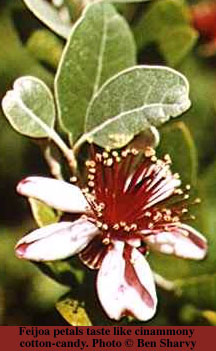
The flower petals are delicious, and if picked without harming the stamen, can be harvested without harm to fruiting. They taste like cinnamon cotton-candy. The fruit is high in iodine and potassium. It has a minty pineapple taste, ripens very late, usually late November, and requires a long growing season. It is good fresh, as a jelly, and is often made into fruit leather; it is not well suited to canning or cooking. The red, edible flowers attract various small birds, but apparently not hummingbirds (which usually make a hummingbirdline for red flowers).
Appearance
A slow-growing evergreen, the dark green oval leaves are about 2" long, thick, with a light gray-green underside. The fuschia-like flowers are pink and red, and come in early summer. Fruit is green (sometimes bluishly so), oblong, about 2-3" across. The tree is typically Y-shaped, 10 to 15 ft. high and wide.
Cultivation
On its own roots, feijoa will survive temperatures down to 12¡ F (-10 C). The fruit ripens in late October or November, so it needs a long growing season. Drought will cause fruit-drop; like the apple, the quality of unshaded fruit deteriorates in intense heat. Summer temperatures in the 80¡ F range are ideal. Less than 75 chilling hours in winter can reduce fruit-production and increase suceptibility to frost damage in spring. A great deal of disagreement exists over whether birds or bees are the principal pollinators of feijoa in North America; most growers suggest hand-pollination. Fruit is borne on new growth.
Comment
The pineapple guava is native to southern Brazil and northern Argentina; it isn't a true guava (or pineapple). The German explorer Sellow discovered it in 1819 (hence its botanical name). The feijoa is commercially cultivated a little around San Francisco, and in New Zealand.
Cultivars of Repute
Coolidge, Nazemetz (reported by some to produce better with cross-pollination), Pineapple Gem, Trask (described as semi-self-fertile by some, not-at-all-self-fertile by others).
General References
[C= cultivation; R = recipes; L = lore; A = all]
* Schneider [R]
* Simmons [C]